
Home

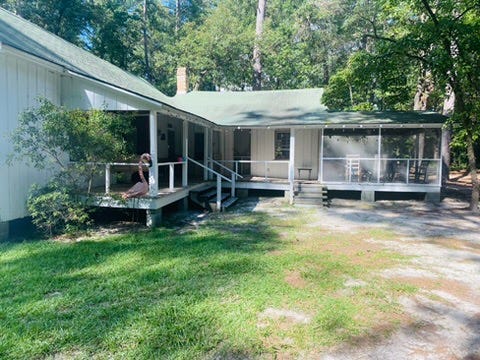
No sooner did the evening sun flap out a black sheet stretched taut with a million, shimmering holes, did my Grandmammy put down her empty martini glass and grab the porch flashlight. She made her way through the woods, gliding across the worn path like she was skating on ice. She never made a grand exit — quietly slipping out at the end of a cousin’s story, catching the screened door before it slammed. Her yellow summer dress faded into the dark trees like a setting sun.
She stepped out onto the Avenue like it was a stage, all lit up in the silky blue moonlight, the tucked-in morning glories her loyal audience. She stared across the field, its wheat rolling in the wind like ocean swells, as the hovering white spotlight drew her eyes.
Riverton, this tucked-away land in the North Carolina Sandhills along the Lumbee River, is where we spend our summers. We’ve lost count of the cousins and aunts and great-this and thats and long ago started calling everyone kin.
Here, my Grandmammy said goodnight to the moon like it was one of her own.
Sometimes I followed along, grabbing hold of her arm, knowing that walks to the moon at Riverton were as sacred as coming to the holy table. She lifted her eyes as if she were bowing her head. And she always returned to the porch like she was washed with more than moonlight.
Grandmammy’s night walks cast anchors to my youth, until adolescence, then adulthood tried to untether me. But all along, the moon was moving, creeping around the earth, trying to warn me through its fluid dance of sliver, to full-faced, that time was rolling on. I guess I thought I could crawl up in that moon’s gentle curve and tuck myself away from the day when Grandmammy would no longer glide across tree roots.
And sure enough, while I was off teenagering, flitting around town with my pack of giggling girlfriends, raising the roofs of our borrowed cars, spitting out lyrics to Notorious B.I.G. and Violent Femmes, my Grandmammy started shuffling instead of gliding.
By the time she and my Granddaddy came to visit me while I was studying in Spain in college, she needed to hold my arm, steadying herself as we perused the wide halls of El Museo del Prado. We quickly removed the tour guide headphones Granddaddy had insisted on renting. Grandmammy was just as interested in my first few months abroad as she was any works by Goya or El Greco, nodding as she passed by their paintings as if they were friendly neighbors. Arm in arm we strolled past the world’s finest art, like two schoolgirls in September catching up after a summer apart.
When we came to Valesquez’ dark and expansive “Las Meninas,” we were both unnerved, silent and still. His shadowy, behind-the-scenes depiction of the royal family lifting the veil on the Spanish monarch, made me feel strangely exposed by the princess’s light and the master’s dark eye. “What do you think about this one, Harriet Settle?”
Harriet Settle. She and Granddaddy were the only ones who called me by my first and middle names. The double name transported me to the lumpy porch cot at Riverton, draped in pink and orange paisley tapestry, where I sat with sunburned legs folded under me, fanning seven cards across from my Grandmammy as she urged me to make a play. “Harriet Settle, it’s your turn.”
The double name sat me right down at the old farm table, peppered with sliced Better Boys, fried cornbread piled on the chipped china plate, and the pale green butter beans simmering in fat back. “Everything’s been blessed. Now pass the creamed corn, Harriet Settle.”
Grandmammy asked again, “Well, what do you think?”
I’d just turned in an entire exam paper at La Universidad de Sevilla about Velasquez. I used all those facts I’d learned to feign knowledge and to keep from telling her what I really wanted to say. Velasquez’s painting was about honesty. And honestly, I was lonely living so far from home. Long ago she had told me that being homesick was the worst feeling in the world. I wanted to tell Grandmammy that I’d give anything to fold myself into her leather suitcase. I knew she’d say “yes” in a New York minute if I asked her to take me home.
Home to the screened porch. Home to the fried cornbread. Home to the cousin stories. Home, hemmed inside the curve of the night moon that wouldn’t dance time away.
Over the next ten years, Grandmammy had her own fluid dance of shuffling across tree roots, to forgetting the names of her kin, to being paralyzed on the hospital bed, to her body’s final surrender when she became one of the eternal stretching pines along the Avenue, propping up the sky of my youth.
I was twenty-nine years old with my own quiver of three when we sang “Shall We Gather at the River” at her funeral. I imagined the old age and dementia slipping off her skin like the silt sand of the Lumbee River. I imagined her swimming again, but the black, Lumbee water shimmering gold.
All I could think about was how my Grandmammy would never have to feel homesick again.
That night, just as the porch laughter was settling down like a pair of scattered dice, I watched my aunt Ella grab the porch flashlight and scoot out the screened door. I watched her fade into the black woods, searching for my Grandmammy’s footprints to lead her in the dark. And I knew that Ella would stand on the dirt stage, washed in shifting shadows with the morning glories bowed beside her. She would turn her eyes to the moon, just a thin sliver, suspended on the flapped-out black sheet with a million shimmering holes.
* This essay was published about a year ago in The Sunlight Press. https://www.thesunlightpress.com/2025/01/26/home/
Consider yourself to be a “Sunburnt Girl” (by way of J.C. M’Neill).
I guiltily envy the culture of the Rivertonians, and the natural, magical atmosphere of their special place. As has been of repeated: “Riverton is not a place, rather an experience.”
The July 4th parade, picnic, and the young Rivertonians swimming in the Lumbee all but certainly insure that the Riverton experience will continue.
Settle…I love this essay, reading about your grandmother AND Ella Mac!